
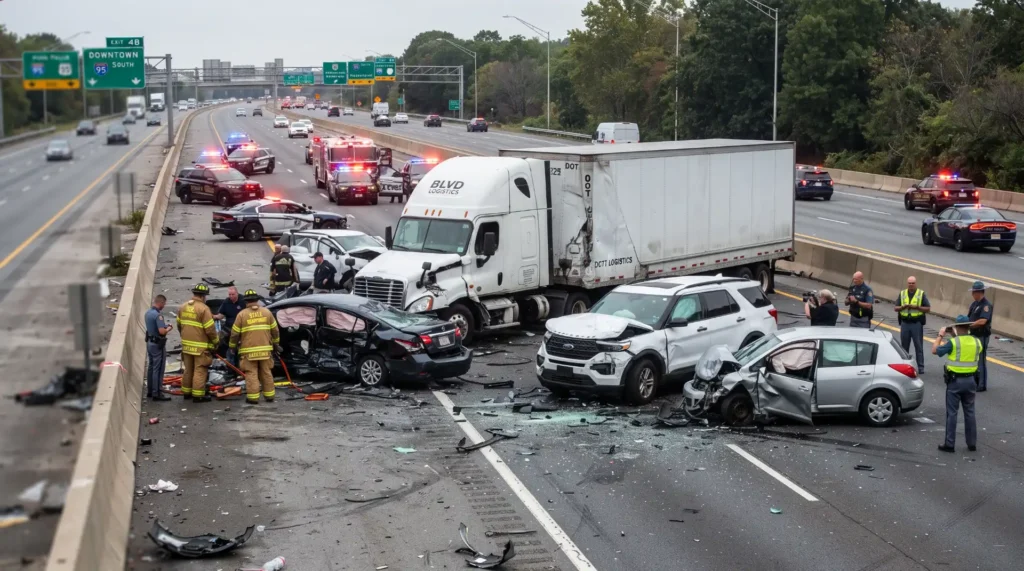
Interstate highways are designed to move large volumes of traffic efficiently, but they also create some of the most dangerous environments for serious collisions. When a commercial truck crashes into other vehicles on a highway, the result can quickly become a multi-vehicle accident involving several drivers, multiple insurance companies, and complicated questions about liability.
A multi-vehicle truck accident is different from a typical traffic collision because responsibility is not always limited to one person. A truck driver may have caused the initial impact, but other drivers, trucking companies, maintenance providers, cargo loaders, or even vehicle manufacturers may have contributed to the events leading up to the crash.
For people injured in these collisions, proving fault is one of the most important parts of pursuing compensation. Insurance companies often investigate these crashes immediately, and they may attempt to reduce their financial responsibility by arguing that another driver caused the accident or that the injuries are unrelated.
Understanding how fault is established after a multi-vehicle truck accident can help injured victims recognize the importance of evidence, investigation, and legal representation.
Why Multi-Vehicle Truck Accidents Are Difficult to Investigate
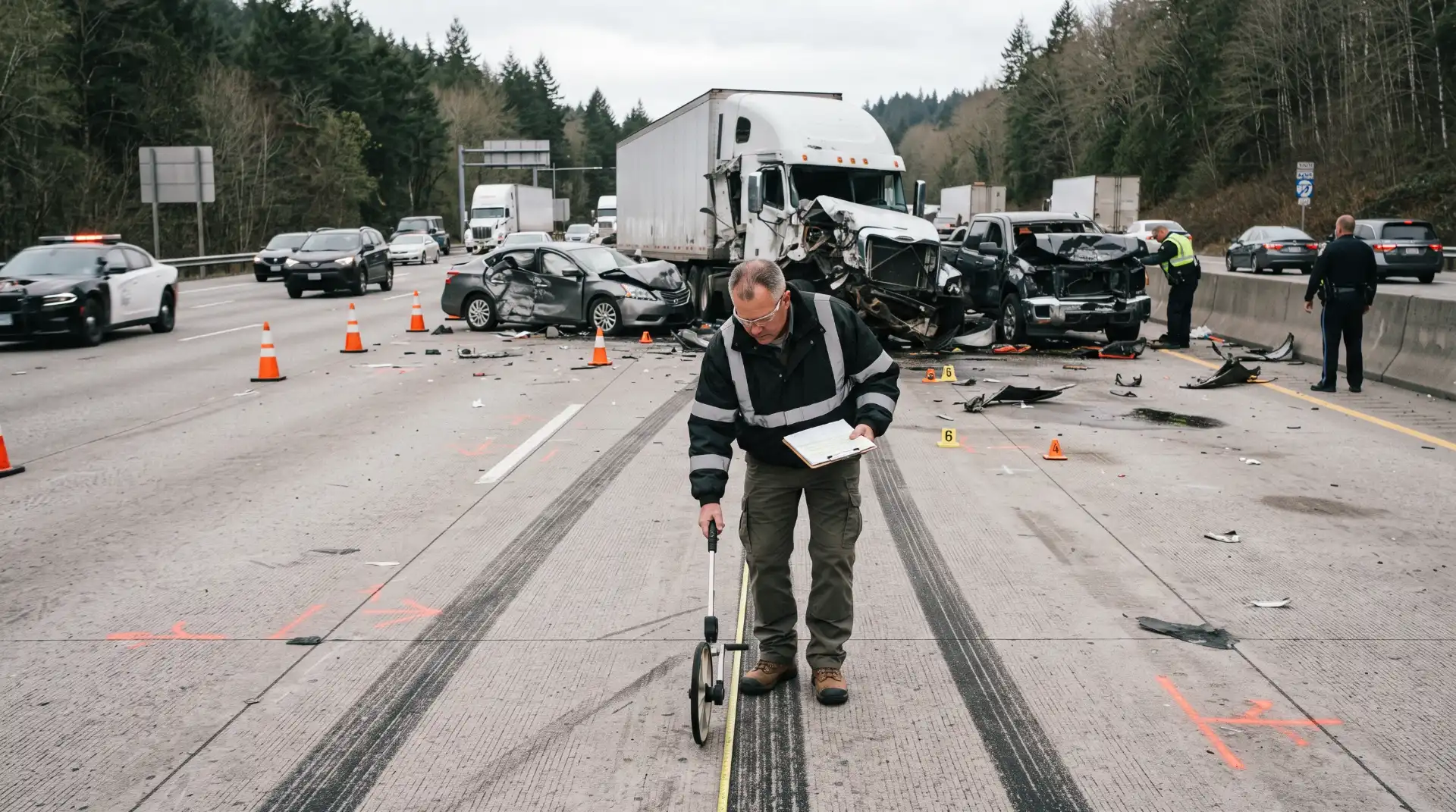
A chain-reaction crash on an interstate highway can happen within seconds. A truck traveling at highway speeds may strike a vehicle that has slowed down due to traffic, which can then cause several additional collisions behind it. Although the final accident scene may involve many vehicles, investigators must determine how the crash began and what actions contributed to each impact.
The first collision is not always the only collision that matters. A driver who failed to maintain a safe distance, a truck operator who was traveling too fast, or a company that ignored safety violations may all play a role in creating dangerous conditions.
Commercial trucks also introduce additional legal and safety considerations. Unlike passenger vehicles, large trucks are subject to federal regulations involving driver qualifications, vehicle maintenance, cargo security, and operating hours. When those rules are violated, the violation may become important evidence in determining liability.
The Federal Motor Carrier Safety Administration (FMCSA) establishes safety regulations for commercial motor vehicles operating throughout the United States. These rules are intended to reduce crashes caused by driver fatigue, unsafe equipment, and improper trucking practices.
Common Causes of Multi-Vehicle Truck Accidents
Many different factors can contribute to multi-vehicle truck accidents on interstate highways. In some cases, the crash is caused by a single negligent action. In other cases, several mistakes combine to create a dangerous situation.
Truck Driver Fatigue and Hours-of-Service Violations
Driver fatigue remains one of the most serious concerns in the trucking industry. Long hours behind the wheel, demanding delivery schedules, and insufficient rest can affect a driver’s ability to react quickly and safely.
A tired truck driver may take longer to recognize slowing traffic, fail to maintain lane position, or lose control of the vehicle. Because commercial trucks require significantly more time and distance to stop compared with smaller vehicles, even a short delay in reaction can cause a devastating collision.
Federal trucking regulations limit how long commercial drivers can operate before taking required rest periods. These hours-of-service rules exist because fatigued driving can create risks similar to other forms of impaired driving.
After a crash, investigators may review electronic logging device records, driver schedules, and company records to determine whether fatigue contributed to the collision.
Speeding and Unsafe Truck Operation
Speed is a major factor in many interstate truck accidents. Large commercial trucks can weigh up to 80,000 pounds when fully loaded, making them much harder to stop or maneuver compared with passenger vehicles.
A truck traveling too fast may be unable to avoid stopped traffic, sudden lane changes, construction zones, or vehicles entering the roadway. When a truck impacts another vehicle at highway speeds, the force of the collision can cause multiple secondary crashes.
Investigators may examine vehicle damage, roadway evidence, driver statements, and electronic truck data to determine whether speed contributed to the accident.
Distracted Driving and Driver Inattention
Truck drivers and other motorists share responsibility for maintaining attention while driving. A moment of distraction on an interstate highway can have serious consequences.
Drivers may become distracted by mobile devices, navigation systems, food, passengers, or other activities inside the vehicle. In a truck accident involving several vehicles, determining which driver was distracted and whether that distraction contributed to the collision can be an important part of the investigation.
Dash camera footage, witness statements, and electronic vehicle data may provide valuable evidence when distraction is suspected.
Improper Cargo Loading and Truck Maintenance Problems
Commercial trucks must be properly maintained and safely loaded before entering the roadway. Mechanical problems or unstable cargo can affect a truck’s ability to stop, turn, and remain under control.
A poorly maintained truck may experience brake failure, tire problems, steering issues, or other mechanical failures. Similarly, improperly secured cargo may shift during transportation and create balance problems that increase rollover risks.
Responsibility may extend beyond the driver if a trucking company failed to perform required inspections or if another company was responsible for loading the cargo incorrectly.

How Investigators Determine Fault After a Truck Accident
Proving fault in a multi-vehicle truck accident requires examining the entire sequence of events. Investigators typically look at physical evidence, driver behavior, vehicle records, and the circumstances surrounding the crash.
Accident Reports and Law Enforcement Findings
Police reports often provide the first official documentation of a collision. Officers may record information about vehicle positions, road conditions, statements from drivers, and possible violations.
However, a police report alone may not provide a complete explanation of liability. Complex truck accidents often require additional investigation because important evidence may only become available later.
For example, a police report may identify the truck as the vehicle that caused the collision, but further investigation may reveal that a trucking company failed to maintain the vehicle or that another driver contributed to the crash.
Accident Reconstruction Analysis
Accident reconstruction experts use scientific methods to determine how a crash occurred. They analyze factors such as vehicle damage, impact locations, roadway markings, and vehicle movement patterns.
In a multi-vehicle truck accident, reconstruction can help answer important questions:
- Which vehicle caused the first impact?
- How fast were the vehicles traveling?
- Could the crash have been avoided?
- Did another driver’s actions contribute?
This type of analysis can be especially valuable when multiple parties disagree about who caused the collision.
Electronic Truck Data and Black Box Evidence
Many commercial trucks contain electronic systems that record important information about vehicle operation. This data may show details about braking, speed, and other driving activity before a crash.
Electronic logging devices can also reveal whether a driver followed federal hours-of-service requirements. If a driver exceeded allowable operating hours before a collision, that information may become relevant when determining fault.
Because electronic evidence can be time-sensitive, preserving this information soon after an accident is important.
Who May Be Responsible for a Multi-Vehicle Truck Accident?
One of the biggest challenges in these cases is identifying every party that may have contributed to the accident.
The truck driver may be responsible if the crash resulted from negligent actions such as speeding, distracted driving, impaired driving, or violating safety regulations.
The trucking company may also share liability if it failed to properly train the driver, ignored safety problems, pressured drivers to violate regulations, or failed to maintain its vehicles.
In some situations, maintenance companies, cargo loading companies, or manufacturers may also be responsible. For example, a defective brake component or improperly secured cargo could contribute to a collision even if the driver was operating the truck carefully.
Because multiple parties may be involved, a complete investigation is necessary before determining who should be held accountable.
The Importance of Evidence in Proving Liability
Evidence is often the foundation of a successful truck accident claim. Unlike ordinary car crashes, commercial truck cases may involve records and information that are controlled by trucking companies.
Important evidence may include photographs of the accident scene, surveillance footage, witness statements, vehicle inspection records, driver qualification documents, electronic logging data, and medical records.
Physical evidence from the crash scene can also be critical. Skid marks, vehicle damage, debris patterns, and roadway conditions may help explain what happened before and during the collision.
The sooner evidence is preserved, the easier it may be to build an accurate picture of the accident.
How Insurance Companies Handle Multi-Vehicle Truck Claims
Truck accident claims often involve large commercial insurance policies and significant financial exposure. Because of this, trucking companies and their insurers usually begin investigating immediately after a serious collision.
Insurance companies may attempt to limit liability by arguing that:
- Another driver caused the crash
- The injuries are unrelated
- The victim shares responsibility
- The damages are less serious than claimed
In multi-vehicle accidents, several insurance companies may become involved, each representing different drivers or businesses. This can make settlement negotiations more complicated.
Injured victims may need to understand not only who caused the crash but also which insurance policies may provide coverage for medical expenses, lost income, and other damages.
Comparative Fault in Multi-Vehicle Truck Accident Cases
Many states use comparative fault rules when multiple parties contribute to an accident. Under these rules, responsibility may be divided among several drivers rather than assigned entirely to one person.
For example, a truck driver may be primarily responsible for failing to stop, while another driver may share partial responsibility for unsafe lane changes. The amount of compensation available may depend on each party’s percentage of fault.
Because multi-vehicle accidents often involve competing explanations of what happened, carefully analyzing each driver’s actions is essential.
How a Truck Accident Lawyer Can Help Prove Fault
Multi-vehicle truck accident cases require more than simply showing that a crash occurred. Injured victims must often demonstrate why the collision happened, who contributed to it, and how the accident caused their injuries.
A truck accident lawyer can help investigate the collision, gather evidence, work with accident reconstruction professionals, and identify all potentially responsible parties.
Legal professionals can also review trucking company records, analyze insurance coverage, and handle communication with insurers while protecting the victim’s interests.
For victims dealing with serious injuries, medical treatment, lost income, and long-term recovery, having a clear understanding of liability can be an important part of seeking fair compensation.
Conclusion
Multi-vehicle truck accidents on interstate highways are among the most complex traffic collisions to investigate. Because several vehicles and parties may be involved, determining fault requires a careful review of evidence, regulations, driver actions, and the circumstances surrounding the crash.
Truck drivers, trucking companies, maintenance providers, cargo companies, and other motorists may all contribute to a collision depending on the facts of the case.
By preserving evidence and conducting a thorough investigation, injured victims can better understand their legal options and identify the parties responsible for their losses.