
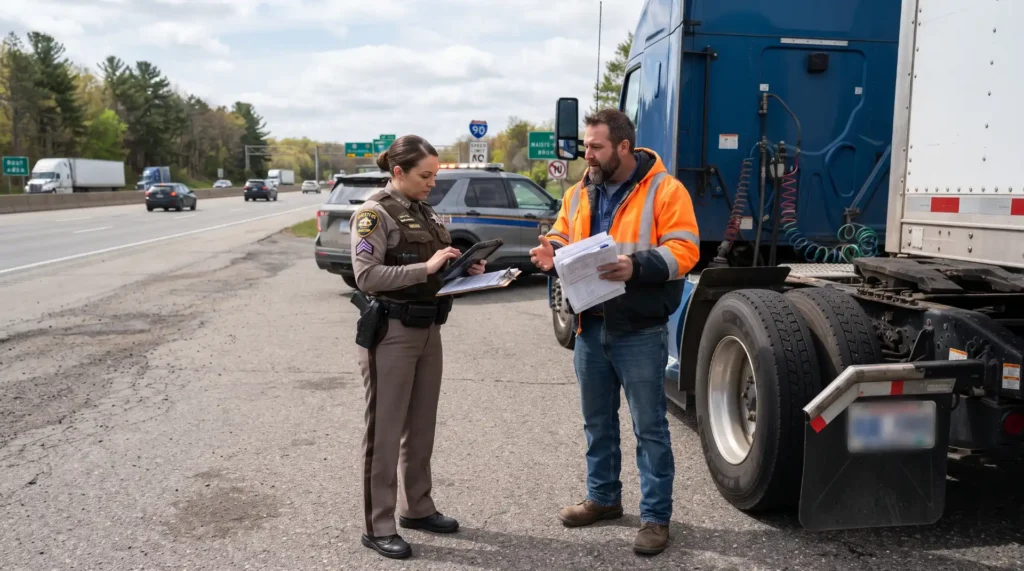
Commercial truck drivers operating across the United States must satisfy numerous federal qualification requirements before getting behind the wheel. Those rules address matters such as licensing, physical qualifications, driving records, hours of service, and the ability to operate large commercial vehicles safely. One requirement that has received renewed attention is a driver’s ability to read and speak English sufficiently for specific safety-related purposes.
The federal English-language proficiency requirement is not new. Under 49 CFR § 391.11(b)(2), a driver operating a commercial motor vehicle in interstate commerce must be able to read and speak English sufficiently to communicate with the general public, understand highway traffic signs and signals, respond to official inquiries, and make entries on required reports and records.
What has changed is the level of federal attention given to enforcement.
Beginning in 2025, the Federal Motor Carrier Safety Administration (FMCSA) strengthened roadside enforcement of the existing requirement. FMCSA subsequently issued revised enforcement guidance in April 2026 explaining how federal personnel should evaluate English-language proficiency during inspections and when a violation can result in a driver being placed out of service. In August 2026, FMCSA also moved forward with a proposed rule intended to codify portions of the enforcement framework.
These developments have generated questions not only for drivers and trucking companies but also for people involved in serious truck crashes.
If a driver involved in a collision could not satisfy federal English-language requirements, does that automatically mean the driver caused the accident? Usually not. However, depending on the circumstances, language-related qualification issues may become one part of a broader investigation into driver qualification, carrier hiring practices, regulatory compliance, communication, and the events leading to the crash.
Understanding that distinction is important when examining English proficiency rules for truck drivers and their possible role in U.S. truck accident cases.
What Are the Federal English Proficiency Rules for Truck Drivers?
Federal regulations establish minimum qualifications for drivers operating certain commercial motor vehicles in interstate commerce.
Under 49 CFR § 391.11, a motor carrier generally may not require or permit someone to operate a covered commercial motor vehicle unless that person meets the applicable driver qualifications.
One of those qualifications concerns English-language ability.
The regulation requires sufficient English proficiency for four practical purposes: communicating with the general public, understanding English-language highway traffic signs and signals, responding to official inquiries, and completing required reports and records.
The rule is therefore tied to specific functions associated with safely operating a commercial vehicle. It does not require a truck driver to have perfect grammar, an American accent, advanced vocabulary, or college-level English.
The central issue is whether the driver can use and understand English sufficiently to perform the safety and regulatory functions identified by federal law.
FMCSA has also advised motor carriers to evaluate English-language proficiency during the driver qualification process rather than waiting for a roadside inspector to discover a problem. The agency recommends assessments capable of determining whether a driver can communicate with enforcement officers and understand highway signs likely to be encountered while driving.
Why English Proficiency Can Be a Truck Safety Issue
Truck drivers routinely process information while operating vehicles that may weigh many times more than a passenger car.
Some of that information is communicated through symbols that require little or no language knowledge. Other information, however, may appear primarily or entirely in English.
A commercial driver may encounter temporary construction instructions, detour signs, hazardous-material directions, inspection instructions, emergency warnings, electronic message boards, weigh-station directions, or communications from police officers.
A misunderstanding does not necessarily cause an accident. Thousands of drivers whose first language is not English operate commercial vehicles safely throughout the United States.
The safety concern arises when a driver’s inability to understand necessary information interferes with an actual driving decision.
For example, investigators might examine whether a driver understood a temporary restriction directing trucks away from a hazardous route, whether the driver could follow a law enforcement officer’s traffic-control instructions, or whether the driver properly understood a warning relating to road conditions.
The meaningful legal question after an accident is therefore usually not simply, “How well did the driver speak English?”
It is more likely to be, “Did the driver’s ability to understand or communicate safety-critical information contribute to what happened?”
That difference can be crucial.
How FMCSA Roadside Enforcement Works
Federal enforcement of the English-language requirement became substantially more visible beginning in 2025.
FMCSA developed an English Language Proficiency assessment process for roadside inspections. The agency’s revised April 16, 2026 policy instructs enforcement personnel on evaluating whether drivers satisfy the requirements of 49 CFR § 391.11(b)(2).
The process focuses in part on whether the driver can respond adequately to official inquiries and understand highway traffic signs and signals.
Under FMCSA’s current enforcement framework, certain violations identified during a roadside inspection can result in an out-of-service designation. FMCSA has stated that its inspection software was configured beginning June 25, 2025 so applicable English-language proficiency violation codes receive the appropriate out-of-service treatment, subject to a specific border-commercial-zone distinction.
Being placed out of service generally means the driver cannot simply continue operating the commercial vehicle as though nothing happened. The violation must be handled according to the applicable enforcement requirements.
That enforcement consequence is significant for motor carriers because the underlying regulation concerns driver qualification.
The 2026 Proposed Rule and Why It Matters
Another important development occurred in August 2026.
FMCSA announced that it was moving to codify the English-language proficiency enforcement standard through rulemaking. Agency records list an English Language Proficiency; Out of Service Criteria proposed rule published in August 2026 involving Parts 390 and 391 of the Federal Motor Carrier Safety Regulations.
The distinction between a proposed rule and an existing regulation matters.
The underlying English-language qualification requirement already exists in 49 CFR § 391.11(b)(2). The 2026 proceeding should not be described as if the federal government had only just created an English requirement for truck drivers.
Rather, the regulatory development concerns how the requirement and related out-of-service criteria are formally incorporated into federal rules.
Truck accident investigations occurring during a changing regulatory environment should therefore identify which requirements and enforcement policies were actually in effect on the date of the crash.
Can an English Proficiency Violation Prove Fault After a Truck Accident?
Not automatically.
A truck driver’s failure to satisfy a federal qualification requirement may be important evidence, but a regulatory violation and legal responsibility for a particular collision are not necessarily the same thing.
Accident liability generally requires an analysis of the driver’s conduct, the carrier’s conduct, causation, applicable federal and state law, and the evidence surrounding the collision.
Consider a crash caused when a truck driver runs a red light because the driver is looking at a cellphone. If investigators later discover an unrelated English-language qualification issue, that issue might be relevant to the carrier’s overall compliance practices, but it would not necessarily explain why the driver entered the intersection.
Now consider a different situation.
A truck approaches a temporary traffic-control area where commercial vehicles are directed to use a specific detour because the normal route cannot safely accommodate them. The driver fails to follow the English-language warning, enters the restricted area, and causes a collision.
In that scenario, investigators may have a stronger reason to examine whether the driver’s ability to understand the instruction contributed to the crash.
The connection between the alleged violation and the accident is what matters.
When English Proficiency May Become Relevant Evidence
A language-related qualification issue may deserve closer attention when the crash involves circumstances in which understanding spoken or written safety information was important.
That could include accidents involving construction zones, detours, emergency traffic control, inspection stations, restricted truck routes, hazardous conditions, low-clearance warnings, temporary road closures, or instructions from police and transportation officials.
Investigators may also examine communication occurring before the collision.
Suppose a dispatcher informed a driver about a route change caused by severe weather. If the driver misunderstood that instruction and continued onto a dangerous road, communications between the driver and motor carrier could become relevant.
Similarly, a driver’s ability to accurately complete reports, logs, or other safety records could become important if inconsistencies appear after a crash.
None of these circumstances establishes negligence by itself. They are factual issues that may need to be considered alongside the rest of the evidence.
Trucking Companies Have Their Own Qualification Responsibilities
An investigation should not necessarily stop with the individual driver.
Federal regulations place responsibilities on motor carriers as well.
FMCSA specifically states that a motor carrier should assess a driver’s qualifications, including compliance with the English-language proficiency requirement, because 49 CFR § 391.11 prohibits a carrier from requiring or permitting an unqualified person to operate a covered commercial vehicle.
FMCSA recommends that carriers evaluate whether drivers can sufficiently communicate with enforcement personnel and understand highway signs they may encounter while driving.
This creates an important question after some truck accidents:
What did the trucking company do before putting the driver on the road?
A carrier’s hiring and qualification procedures may be examined to determine whether it appropriately evaluated the driver.
If evidence indicates that company personnel recognized a serious qualification problem but nevertheless allowed the driver to operate an interstate commercial vehicle, that information could become relevant to claims involving the carrier’s own conduct, depending on the applicable law and facts.
Driver Qualification Files May Provide Important Information
Commercial trucking litigation often involves records that would rarely exist after an ordinary passenger-car crash.
Driver qualification materials are one example.
Depending on the case and applicable recordkeeping requirements, investigators may seek documents relating to the driver’s application, licensing, employment history, safety performance, training, qualification process, and other regulatory records.
If English proficiency becomes a legitimate issue, records documenting the carrier’s evaluation process could also become relevant.
Did the company interview the driver?
Was the interview conducted in a manner capable of evaluating the driver’s ability to communicate?
Did anyone document concerns?
Was the driver able to understand road signs and official questions?
Did the carrier use a meaningful qualification procedure, or was the process merely paperwork?
Answers to questions like these may help establish whether the carrier took reasonable steps to comply with federal qualification requirements.

Evidence That May Be Examined After the Crash
The most useful evidence will depend on how the accident occurred.
A truck accident investigation involving possible communication or qualification problems may include the police crash report, photographs and video, dash-camera footage, electronic logging device information, electronic control module data, driver qualification documents, inspection history, dispatch communications, training records, GPS information, and witness statements.
Roadside inspection records can be particularly significant if the driver had previously been cited for qualification-related problems.
Investigators may also look at electronic messages between the driver and dispatcher, especially when routing instructions, weather warnings, delivery changes, construction problems, or emergency conditions were discussed before the crash.
Physical evidence remains essential.
For example, if a truck ignored a warning sign before entering a dangerous area, photographs showing where the sign was positioned, what it said, whether it was visible, and how much time a driver had to respond could be more useful than general assumptions about language ability.
A strong investigation connects evidence to the actual sequence of events.
Previous English-Language Violations Could Raise Additional Questions
A prior English-language proficiency violation does not automatically establish liability for a later collision.
It could, however, prompt further investigation.
Suppose inspection records show that a commercial driver had previously been found unable to satisfy federal English-language proficiency requirements.
Investigators may want to determine what happened afterward.
Was the problem corrected?
Did the carrier know about the violation?
What steps were taken before the driver returned to service?
Did the company reassess the driver’s qualifications?
Was the later accident connected in any meaningful way to the same deficiency?
The answers could be relevant when evaluating whether a motor carrier appropriately responded to a known qualification problem.
Again, causation remains essential. A historical violation should not simply be treated as proof that the driver caused an unrelated accident months later.
English Proficiency Should Not Be Confused With Nationality or Accent
Discussions about language requirements can easily become inaccurate or unfair if nationality, ethnicity, immigration status, or accent is treated as a substitute for evidence.
The federal regulation focuses on functional English-language proficiency for specified commercial-driving responsibilities.
A driver can speak English with a strong accent and fully satisfy the regulation.
A driver may also speak multiple languages and be exceptionally qualified to operate a commercial vehicle.
The important question is whether the driver possessed the level of English ability required by the regulation—not where the driver was born, what language is spoken at home, or whether the driver’s speech sounds like that of a native English speaker.
Truck accident investigations should therefore rely on objective evidence rather than stereotypes.
Understanding Highway Signs Is Only One Part of the Rule
Public discussions sometimes reduce the English-language requirement to whether a driver can read road signs.
The regulation is broader.
Drivers must have sufficient English ability to perform several functions, including responding to official inquiries and completing required reports and records.
That can matter after a truck accident because commercial drivers interact with police officers, inspectors, motor carriers, dispatchers, and other parties whose communications may relate directly to safe operation.
For example, a driver who cannot understand an officer directing trucks around a crash scene could present a different safety concern from a driver who merely struggles with casual conversation.
The federal standard is designed around practical functions required of commercial drivers rather than conversational fluency in every situation.
The Role of Roadside Inspection Records in Accident Cases
FMCSA and state partners conduct large numbers of commercial vehicle inspections across the country.
Inspection histories can sometimes provide a window into the safety record of a driver or carrier before a collision.
If an inspection identifies an English-language proficiency violation, the record may reveal the nature of the violation and whether an out-of-service action occurred.
Such evidence may be especially relevant when a crash occurs shortly afterward or when questions arise about whether a carrier continued using a driver despite a known qualification problem.
However, inspection data should be interpreted carefully.
A violation code indicates a regulatory finding during an inspection. It does not by itself reconstruct a later collision or determine civil liability.
Accident cases require a broader analysis.
Other Federal Trucking Rules May Be More Directly Connected to the Crash
English proficiency is only one part of commercial driver qualification.
Many serious truck accidents involve other regulatory and safety issues that may have a much clearer causal relationship to the collision.
Driver fatigue, excessive hours, speeding, distracted driving, impairment, improper cargo securement, inadequate vehicle maintenance, defective brakes, unsafe lane changes, insufficient following distance, and negligent hiring or supervision may all be relevant depending on the facts.
For that reason, investigators should avoid focusing so heavily on one qualification issue that more important evidence is overlooked.
For example, a collision may initially raise concerns about communication, only for electronic logging device data to show that the driver had exceeded applicable driving limits and was severely fatigued.
In another case, vehicle inspection records may establish that the carrier repeatedly ignored brake defects.
Truck accident claims often involve several overlapping issues.
Why Early Evidence Preservation Matters
Commercial trucking evidence does not necessarily remain available indefinitely.
Electronic data may be overwritten. Vehicles may be repaired. Surveillance video can disappear. Personnel may leave the company. Dispatch information and internal communications may be retained according to company systems and applicable legal obligations.
For that reason, serious truck crashes often require prompt investigation.
When driver qualification is an issue, preserving relevant personnel, training, inspection, and communication records may be particularly important.
Evidence preservation can also help prevent speculation.
Rather than assuming that language played a role in the collision, investigators can determine whether there is actual evidence connecting communication or comprehension to the crash.
Federal Regulations and State Accident Law Work Together
Federal trucking regulations establish safety and qualification requirements, but truck accident claims are generally pursued under applicable state civil law.
That means the legal effect of a federal regulatory violation may vary according to the jurisdiction, the claims being asserted, and the circumstances of the crash.
Questions may include whether the regulation was intended to protect against the type of harm involved, whether a violation can be used as evidence of negligence, whether state law recognizes negligence per se under the circumstances, and whether the alleged violation actually contributed to the collision.
Because state negligence rules differ, the same regulatory fact may not have precisely the same legal effect in every state.
The United States also has different comparative-fault and contributory-negligence systems, further emphasizing why truck accident liability requires a case-specific analysis.
How English Proficiency Could Affect a Trucking Company’s Liability
A trucking company’s potential responsibility may extend beyond liability arising from the driver’s actions.
Depending on state law and the available evidence, claims may involve allegations concerning negligent hiring, qualification, retention, training, supervision, or other direct conduct by the motor carrier.
An English-language proficiency issue could become relevant if evidence shows that the carrier failed to conduct an appropriate qualification assessment or ignored known concerns.
For example, a carrier might have records showing that a driver repeatedly could not understand basic highway instructions during training but was nevertheless dispatched on interstate routes.
If a later collision occurred because the driver misunderstood a safety-critical highway instruction, the company’s earlier knowledge could take on greater significance.
In contrast, if the crash was caused by an unrelated mechanical failure that nobody could reasonably connect to the driver’s English ability, focusing heavily on language proficiency may add little to the liability analysis.
Context is everything.
FMCSA Is an Important Source for Current Information
Because federal trucking regulations and enforcement policies can change, accident victims, drivers, motor carriers, and safety professionals should rely on current official information rather than older summaries circulating online.
The Federal Motor Carrier Safety Administration publishes the federal driver qualification regulations, English-language proficiency guidance, enforcement policies, frequently asked questions, and rulemaking information used throughout the commercial trucking industry. FMCSA English Language Proficiency Roadside Enforcement Policy FAQs
For an accident occurring in 2026 or later, the date of the collision matters because enforcement guidance and rulemaking may continue to evolve.
What Should Be Investigated When English Proficiency Is Suspected?
A careful investigation should begin with the circumstances of the crash rather than assumptions about the driver.
Important questions may include whether the driver missed or misunderstood a safety instruction, whether the carrier properly evaluated the driver’s qualifications, whether previous inspection records identified a similar problem, and whether there is objective evidence linking language comprehension to the collision.
Investigators should also determine whether other factors provide a more direct explanation for the accident.
This approach keeps the focus where it belongs: on evidence, safety, regulatory compliance, and causation.
English Proficiency Is One Piece of a Much Larger Truck Accident Investigation
The renewed federal focus on English-language proficiency has made 49 CFR § 391.11(b)(2) more visible within the trucking industry.
FMCSA’s enforcement actions underscore that the requirement is considered part of commercial driver qualification. At the same time, accident cases require more than proof that a regulation was violated.
A driver can violate a federal qualification rule without that violation causing a particular crash.
Conversely, when an inability to understand highway information, official directions, or other safety-critical communications contributes directly to a collision, English-language proficiency may become highly relevant evidence.
The motor carrier’s conduct may matter as well. Companies responsible for putting commercial drivers on the road are expected to evaluate whether those drivers satisfy applicable federal qualifications.
For people injured in commercial truck accidents, this is one reason these cases can require a much broader investigation than ordinary passenger-vehicle collisions.
Driver qualification records, inspection histories, electronic vehicle data, dispatch communications, company policies, training materials, video, physical evidence, and federal compliance records may all help explain not only how a crash occurred, but also whether it could reasonably have been prevented.
Ultimately, English proficiency should neither be ignored when it has a genuine connection to an accident nor treated as automatic proof of negligence when it does not.
The central question remains the same as in any serious trucking case: What does the evidence show actually contributed to the crash?