
Truck Parking Shortages and Fatigue Related Highway Accidents
Truck parking shortages can create safety problems when commercial drivers struggle to find legal places to rest before reaching federal driving limits. Drivers may spend additional time searching for spaces, stop in less suitable locations, or face disrupted rest schedules. These conditions can become relevant when fatigue contributes to a serious highway truck accident.
Truck parking may seem like a basic infrastructure issue, but it has become an important part of the national conversation about commercial vehicle safety. Thousands of tractor trailers move through American freight corridors every day, and many drivers need dependable places to stop before ending their permitted driving periods.
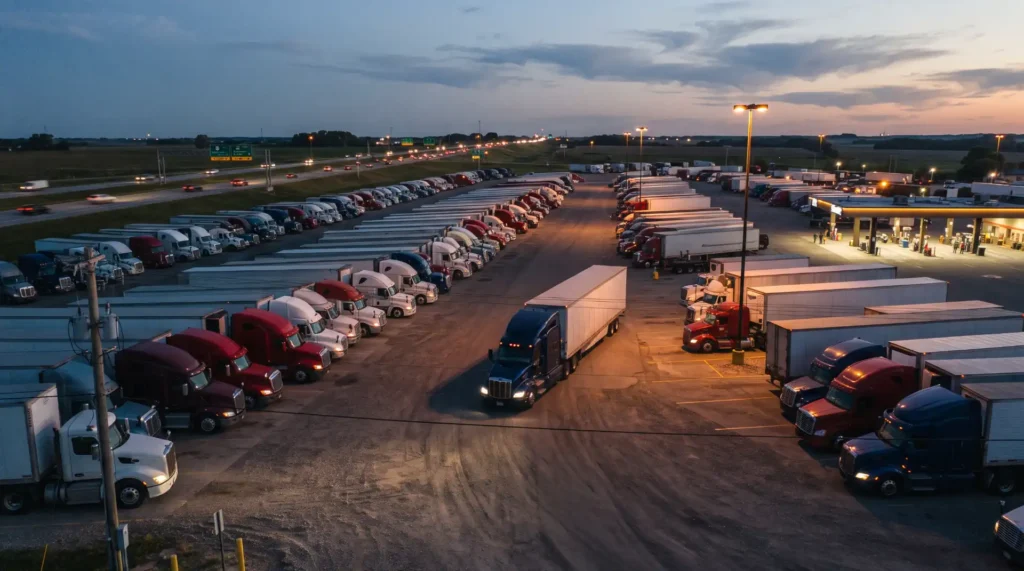
The problem becomes especially visible in the evening and overnight hours. Rest areas and commercial truck stops along busy freight routes can fill quickly. Drivers who reach these locations later in their shifts may discover that every designated space is occupied.
The Federal Highway Administration describes truck parking shortages as a national safety concern. FHWA also notes that drivers who cannot find official parking may use highway shoulders, ramps, or vacant lots, creating possible hazards for truck drivers and other motorists. Readers can learn more through the Federal Highway Administration’s truck parking resources.
Understanding the connection between limited truck parking and driver fatigue can help explain why parking availability matters after certain commercial vehicle crashes.
Why Truck Parking Matters to Highway Safety
Commercial drivers operate under schedules that differ substantially from ordinary daily commuting. Long haul truckers may travel hundreds of miles during a single driving period while transporting freight between distribution centers, warehouses, ports, retailers, and manufacturing facilities.
They cannot simply stop anywhere when they need rest.
A tractor trailer requires considerable space. A driver needs a location where the vehicle can enter safely, maneuver, park without obstructing traffic, and later return to the highway.
Suitable locations often include commercial truck stops, public rest areas, designated parking facilities, and other properties that permit commercial vehicle parking.
Problems arise when demand exceeds available capacity.
FHWA has identified common truck parking challenges across the United States, including shortages along major freight corridors and difficulties associated with limited parking information and delivery schedules. Federal research has also documented trucks using freeway ramps and shoulders when regular parking is unavailable.
This creates two related safety concerns. A tired driver may remain on the road longer while looking for somewhere to stop. Alternatively, the driver may park in an area that exposes the truck to passing traffic.
The Connection Between Truck Parking and Driver Fatigue
Truck driver fatigue can affect reaction time, attention, judgment, lane control, and the ability to respond to changing traffic conditions.
Commercial driving also involves long periods of sustained attention. Drivers need to monitor traffic, mirrors, road signs, weather, construction zones, merging vehicles, and changing highway speeds.
Adequate sleep plays an important role in maintaining that attention.
The National Institute for Occupational Safety and Health states that lack of sleep increases the risk of drowsy driving and vehicle crashes. NIOSH also provides sleep guidance specifically for truck drivers because fatigue remains a recognized transportation safety issue. Readers can review the agency’s sleep guidance for truck drivers.
Parking shortages can complicate rest planning.
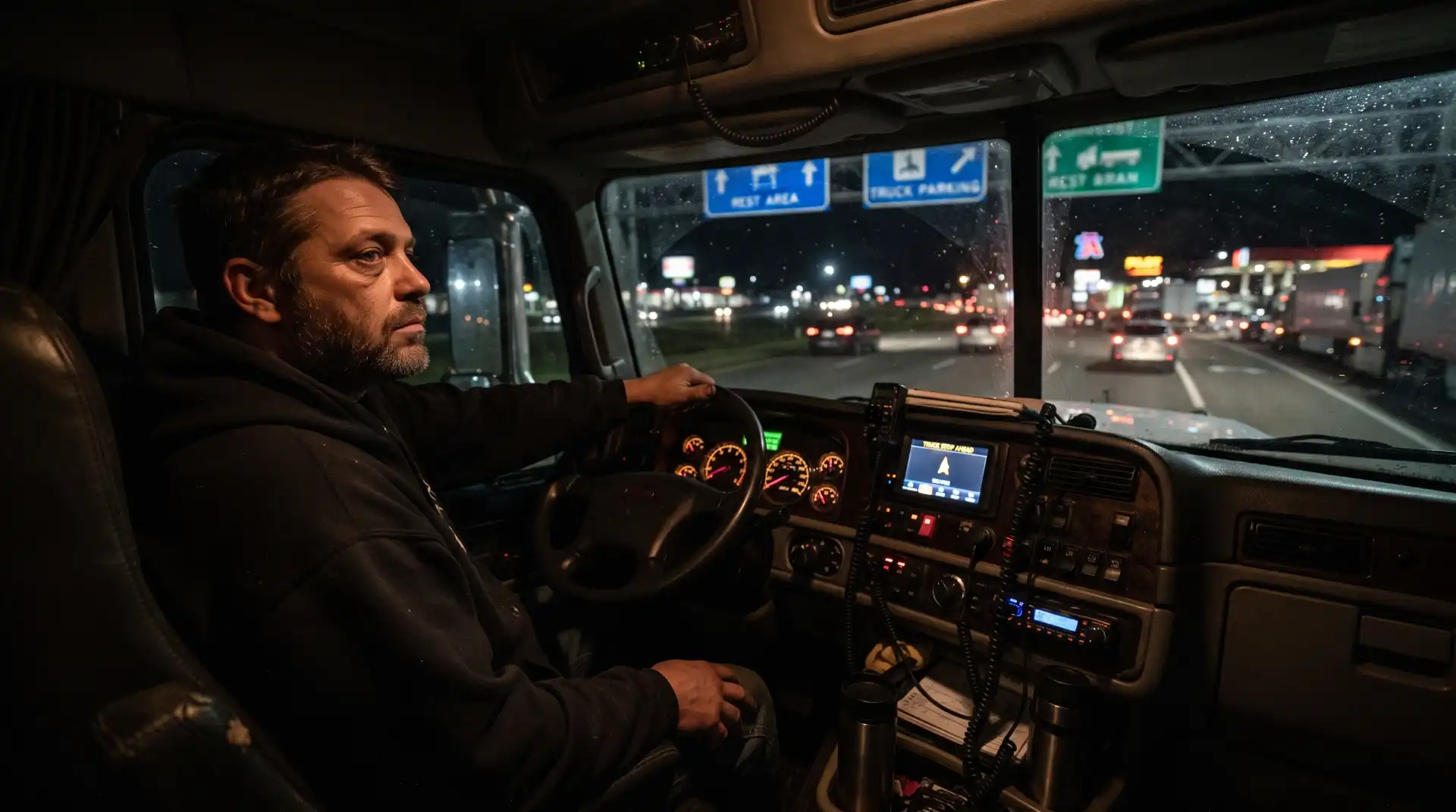
A driver may plan to stop at a rest area near the end of a shift only to discover that the parking lot is full. The driver then needs to decide where to search next while remaining aware of applicable hours of service limits.
Even when the next facility is relatively close, searching for parking can add stress and additional driving during a period when the driver may already feel tired.
Federal Hours of Service Rules Affect When Drivers Need to Stop
Federal hours of service rules place limits on how long many interstate commercial drivers may operate.
For property carrying commercial drivers, FMCSA generally permits up to 11 hours of driving after 10 consecutive hours off duty. A driver generally cannot continue driving beyond the 14th consecutive hour after coming on duty. Federal rules also address breaks and weekly duty limits.
More information is available through the Federal Motor Carrier Safety Administration’s hours of service summary.
These regulations create a practical need for drivers to identify parking before their available driving time expires.
A driver cannot safely assume that a parking space may appear exactly when needed.
Many drivers begin looking for a stopping location earlier than the end of their available duty period. The process may reduce productive driving time, but waiting too long can leave few legal choices.
This interaction between federal driving limits and parking availability is one reason truck parking infrastructure has received continued federal attention.
What Happens When Truck Stops and Rest Areas Are Full?
A full truck stop does not make the driver’s need for rest disappear.
The driver may continue to another commercial facility, search for a public rest area, look for approved parking elsewhere, or find another lawful location.
Each additional mile requires more driving.
Conditions become more complicated at night because parking demand often increases during evening and overnight periods. FHWA’s Jason’s Law research identified recurring shortages and noted that parking demand generally becomes higher during early evening and overnight hours.
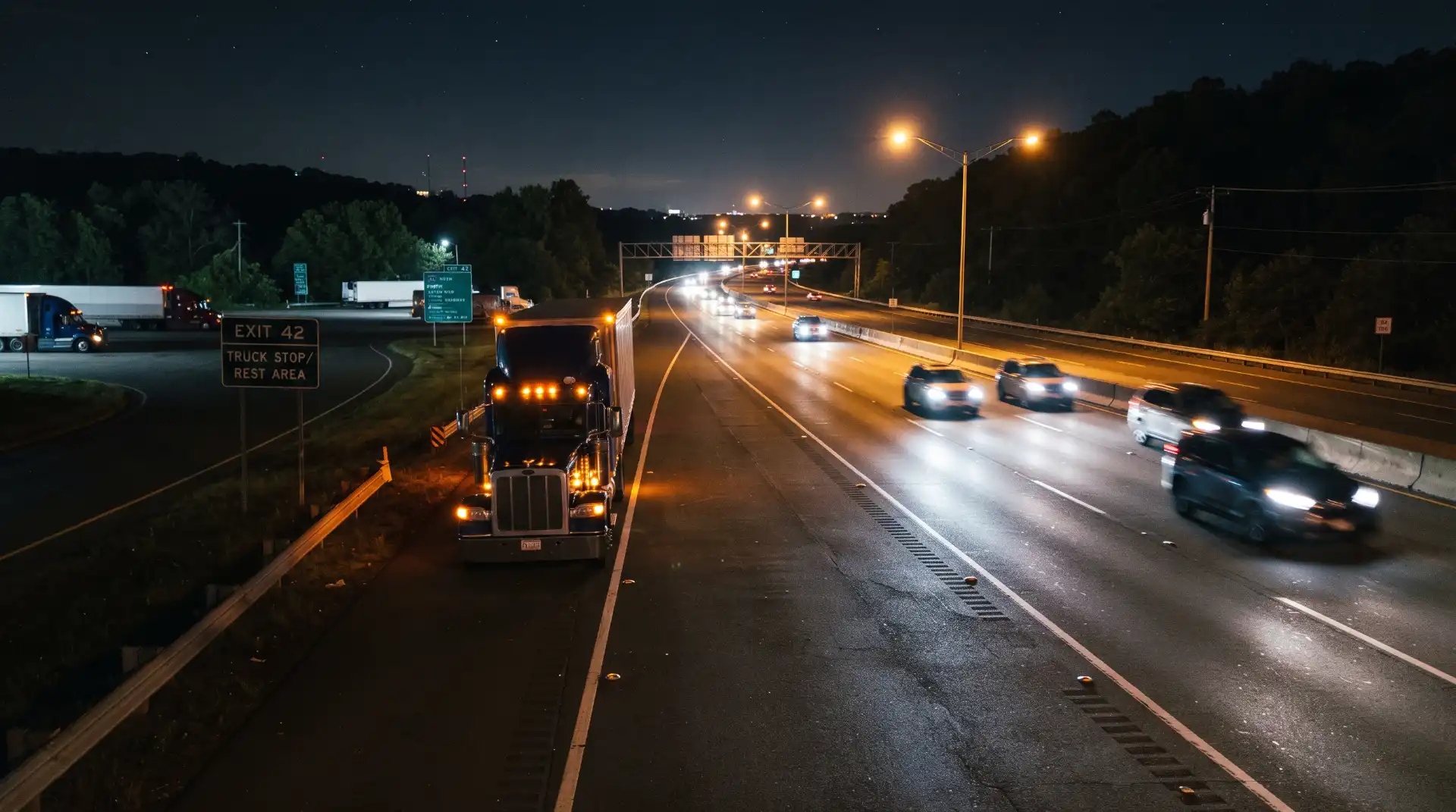
Some drivers may encounter trucks already parked along entrance ramps, exit ramps, or highway shoulders.
Those areas present separate risks.
A passenger vehicle traveling at highway speed may have limited time to react to a large stationary truck near the roadway. Darkness, rain, fog, curves, narrow shoulders, and poor visibility can make the situation more difficult.
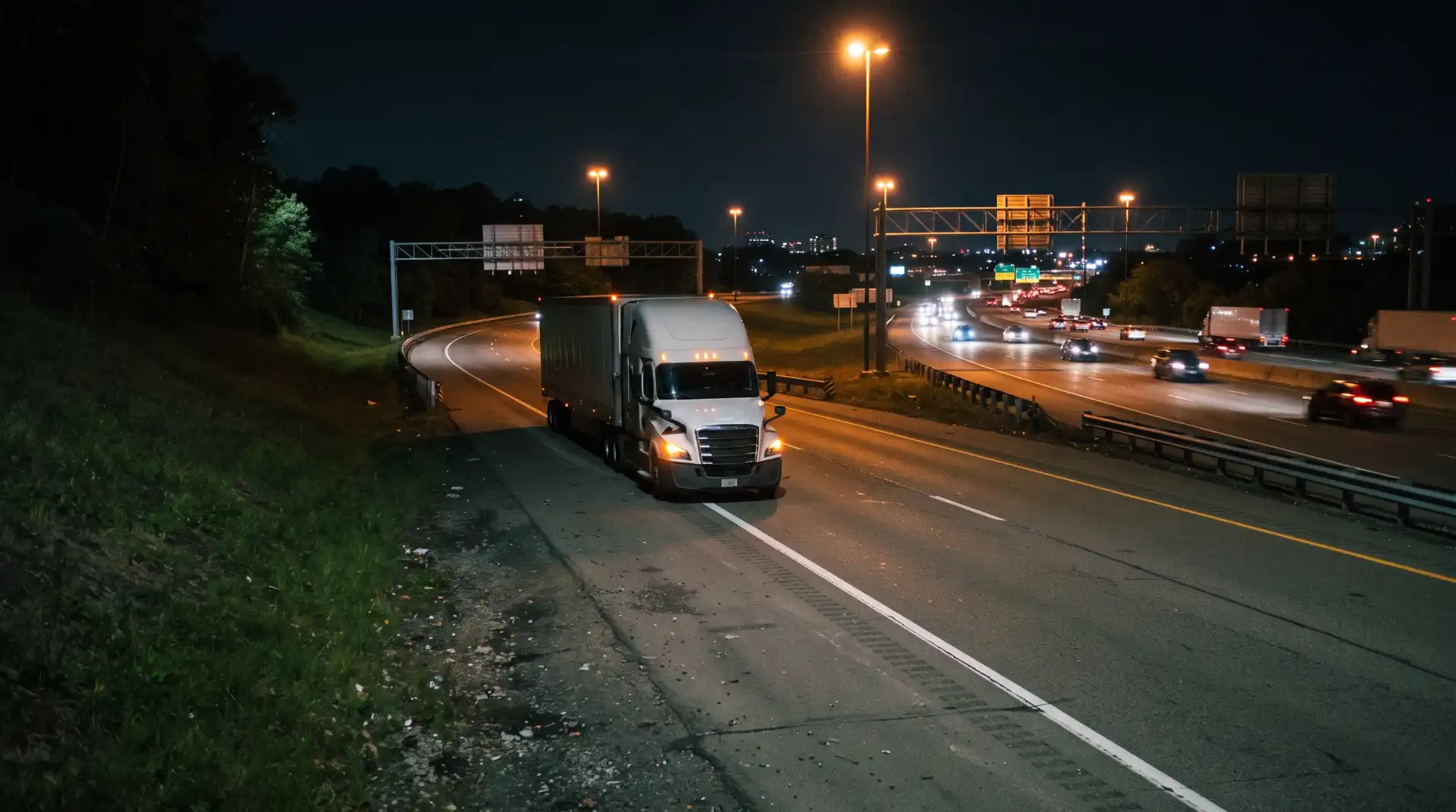
A tractor trailer parked partly within a travel lane creates an even greater concern.
Roadside Truck Parking Can Create Serious Collision Risks
Crashes involving parked commercial trucks can produce severe consequences because of the size and structure of tractor trailers.
One common scenario involves a passenger vehicle leaving the normal travel lane and striking the rear or side of a parked trailer.
Another may involve a truck entering or leaving an unauthorized parking area near a ramp.
Investigators may need to determine exactly where the commercial vehicle was positioned. They may examine whether it blocked any portion of the roadway, whether its lights were operating, and whether other drivers had enough distance to identify the truck.
Road design can also matter.
A wide paved shoulder creates different circumstances from a narrow ramp with limited visibility. Investigators may examine roadway markings, lighting, signs, guardrails, sight distance, nearby parking availability, and the position of the truck.
Responsibility in these crashes depends on the specific facts.
The presence of a parked truck does not automatically establish fault. Another motorist may have been speeding, distracted, impaired, or otherwise negligent.
In other situations, the manner or location in which a commercial truck was parked may become part of the liability analysis.
Fatigue Related Truck Accidents May Occur Before the Driver Parks
Not every parking related fatigue crash involves a stationary truck.
A driver searching for parking may become involved in a collision while still traveling.
Fatigue may contribute to lane drifting, delayed braking, missed traffic signals, inconsistent speed, or difficulty responding to congestion.
A tired truck driver approaching slowed traffic may react later than an alert driver. This is especially concerning because a loaded commercial truck needs substantial distance to slow or stop.
Fatigue may also become relevant when a driver overlooks an exit or passes an intended rest location.
The driver might continue searching while already approaching the end of a demanding shift.
NHTSA cautions that drowsy driving crashes can be difficult to measure precisely because fatigue does not leave the same clear evidence associated with some other forms of impaired driving. The agency identifies signs such as crossing roadway lines or hitting rumble strips as possible indicators of drowsiness.
Because fatigue can be difficult to identify from the crash scene alone, investigators often need additional evidence.
Evidence That May Show Fatigue After a Truck Accident
Truck accident investigations can involve far more information than a standard passenger vehicle collision.
Electronic logging device records can help establish when the driver started working, how long the truck operated, and when the driver recorded off duty periods.
Investigators may compare those records with GPS information, dispatch communications, toll data, fuel purchases, delivery documents, bills of lading, and truck stop receipts.
Electronic information may help reconstruct the driver’s route before the crash.
For example, GPS records might show that the driver entered several parking facilities before continuing down the highway. Dispatch messages could document discussions about parking or delivery schedules.
Dash camera footage might show repeated lane drifting or delayed reactions before a collision.
Witnesses can also provide useful context.
Other drivers may report erratic movements. First responders may record observations concerning the truck driver’s condition after the accident.
Our existing guide on the importance of gathering evidence after a truck accident explains additional forms of evidence that may become relevant after a commercial vehicle crash.
No single item necessarily proves fatigue. Investigators often need to consider several sources together.
Electronic Logging Devices Can Help Reconstruct the Driver’s Schedule
Electronic logging devices are particularly relevant when questions arise about driving hours and rest periods.
An ELD records duty status information for drivers subject to applicable federal logging requirements.
These records may show when a driver changed from driving to off duty status, when the truck moved, and whether recorded driving periods complied with hours of service requirements.
However, an ELD does not necessarily show whether a driver actually slept during an off duty period.
A driver might legally spend several hours off duty but still receive poor quality sleep because of noise, stress, uncomfortable conditions, interruptions, or other circumstances.
This distinction matters in fatigue investigations.
Legal compliance with hours of service rules and actual driver alertness are related issues, but they are not always identical.
Parking Search Data May Add Context to a Crash Investigation
Technology can provide additional insight into what occurred before a collision.
Modern fleets may use GPS tracking and telematics systems that record vehicle locations throughout a trip.
If a crash occurs after a driver spent considerable time searching for parking, location data could document that movement.
Records might show the truck entering a rest area and leaving shortly afterward. The same truck might then travel to several additional facilities before finally stopping or becoming involved in an accident.
That pattern does not automatically establish negligence.
However, it can provide useful context when combined with driving hours, witness statements, video footage, and other evidence.
Investigators may also compare the driver’s actions with nearby parking options available at the time.
Trucking Company Scheduling Practices May Matter
Truck drivers operate within a larger freight system.
Motor carriers, dispatchers, shippers, receivers, brokers, warehouses, and delivery schedules can affect when and where a driver travels.
A trucking company may establish routes, delivery windows, dispatch instructions, and other operational expectations.
When fatigue becomes an issue after a collision, investigators may examine whether company practices contributed to the circumstances.
For example, records might show repeated messages asking a driver to meet a difficult delivery schedule despite limited available driving time.
Other cases may show that a carrier had policies encouraging drivers to plan parking well before their duty periods ended.
The facts can vary significantly.
Our article about understanding truck accident liability discusses how drivers, motor carriers, maintenance contractors, manufacturers, and other parties may become relevant in commercial vehicle cases.
Why Truck Parking Remains a National Issue in 2026
Truck parking is not simply an older transportation problem that has disappeared.
Federal transportation agencies continue to address parking availability through infrastructure programs and safety initiatives.
In March 2026, USDOT announced nearly $1 billion in available Safe Streets and Roads for All funding and specifically identified additional truck parking as one eligible safety improvement.
Federal transportation officials also announced infrastructure funding in June 2026 that included support for truck parking projects. Current FY 2026 INFRA materials include a dedicated funding track for commercial motor vehicle parking projects.
These programs show that truck parking remains part of the broader U.S. transportation safety discussion.
FHWA’s truck parking program also continues to provide information about federal funding eligibility, Jason’s Law, research, and the National Coalition on Truck Parking.
Jason’s Law and the Push for Safer Truck Parking
Federal involvement in truck parking expanded significantly after the creation of Jason’s Law.
Jason’s Law established a national priority focused on addressing shortages of long term parking for commercial vehicles on the National Highway System.
The law requires federal assessment of truck parking capacity and needs.
FHWA research performed under Jason’s Law has documented shortages across numerous states and freight corridors. Researchers identified problems near areas with heavy freight activity, dense populations, ports, and manufacturing centers.
The research also identified trucks parking in unofficial locations, including freeway ramps and shoulders.
These findings help illustrate why parking infrastructure and roadway safety are connected.
Technology May Help Drivers Find Parking Earlier
Adding physical parking spaces is one approach to the problem.
Better parking information may also help.
Some transportation agencies and private operators use digital systems that provide information about truck parking availability.
Mobile applications, roadside signs, sensors, and parking management systems can give drivers a better idea of whether spaces remain at upcoming facilities.
Real time information may help drivers make parking decisions earlier instead of arriving at a full facility near the end of a duty period.
USDOT has previously supported technology designed to improve truck parking information management, and federally funded projects have included parking facilities with tools that help drivers locate available spaces.
Technology does not create additional physical space by itself, but it can help drivers use existing capacity more effectively.
Planning Rest Stops Can Reduce Parking Pressure
Drivers and motor carriers can treat parking as part of route planning rather than an issue addressed only at the end of a shift.
A driver traveling through a major freight corridor may identify several possible stopping locations before beginning the trip.
Alternative locations can become useful when the preferred facility is already full.
Carriers can also consider parking conditions when scheduling deliveries and dispatching loads.
Allowing realistic travel and rest planning may reduce pressure on drivers who need to balance delivery obligations with hours of service requirements.
Parking conditions can change quickly, particularly during evening hours, severe weather, construction, or heavy freight periods.
No planning system removes every challenge, but considering parking earlier can reduce last minute decisions.
What Other Motorists Should Know About Trucks Parked Near Highways
Passenger vehicle drivers also play a role in preventing collisions around parked commercial vehicles.
Motorists should remain attentive near rest areas, truck stops, ramps, and highway shoulders.
Commercial trucks may enter or leave these locations at lower speeds than highway traffic.
At night, drivers should pay close attention to traffic patterns and vehicles near the edge of the roadway.
A truck that appears to be moving in the distance might actually be stationary.
Drivers should also avoid distracted driving and leave enough space to respond to unexpected roadway conditions.
Highway safety depends on the actions of everyone using the road.
How Liability May Be Evaluated After a Fatigue Related Truck Accident
Determining responsibility requires more than identifying that a driver was tired.
Investigators need evidence connecting fatigue or another unsafe action to the collision.
They may examine whether the truck driver exceeded applicable driving limits, failed to respond to obvious signs of fatigue, or continued operating despite unsafe conditions.
The motor carrier’s role may also receive attention.
Company records could reveal scheduling practices, prior hours of service violations, dispatch instructions, or safety policies.
In a roadside parking collision, investigators may consider where the truck was parked, whether the location permitted commercial parking, and whether the vehicle obstructed traffic.
They may also evaluate the actions of the other driver.
Multiple parties can sometimes contribute to the same crash. Our guide about multi vehicle truck accidents on interstate highways discusses how evidence can help separate the actions of different drivers after complex highway collisions.
Why Evidence Preservation Matters
Commercial trucks can generate substantial electronic data.
Some information may remain on the truck itself, while other records may exist within company systems or third party platforms.
Potential evidence can include ELD records, GPS history, telematics data, dash camera recordings, dispatch messages, electronic control module information, inspection records, and driver qualification documents.
Parking receipts and fuel records may also help establish the truck’s movements.
Preserving relevant records allows investigators to compare the driver’s official schedule with the truck’s actual route.
Photographs from the crash scene can provide additional evidence, particularly in collisions involving roadside parking.
Images may show the exact location of the truck, available shoulder width, lighting conditions, roadway markings, warning devices, nearby ramps, and sight distance.
Truck Parking Is Both an Infrastructure and Safety Issue
The truck parking shortage involves more than convenience for commercial drivers.
It intersects with driver fatigue, hours of service compliance, freight scheduling, highway design, roadside safety, and infrastructure planning.
When adequate parking is unavailable, drivers may face difficult choices near the end of their available driving periods.
Some may spend additional time searching for legal parking. Others may encounter already crowded ramps and shoulders.
These conditions do not mean every truck accident near a parking facility involves fatigue or unsafe parking.
Each collision requires its own investigation.
Still, the national attention directed toward truck parking shows that safe rest locations form an important part of the commercial transportation system.
Final Thoughts
Truck parking shortages remain a significant issue along U.S. freight corridors. Federal transportation agencies continue to recognize the shortage as a safety concern and support projects intended to expand or improve commercial vehicle parking.
The issue becomes especially important when drivers approach the end of long shifts and need a safe location to rest. Limited parking can lead to additional searching, disrupted rest planning, and trucks stopping in locations near active highway traffic.
After a fatigue related truck accident, investigators may examine driver logs, GPS information, dispatch records, parking activity, company scheduling practices, electronic truck data, and physical evidence from the roadway.
Together, these records can help determine what happened before the collision and whether fatigue, parking conditions, driver conduct, carrier practices, or another factor contributed to the crash.