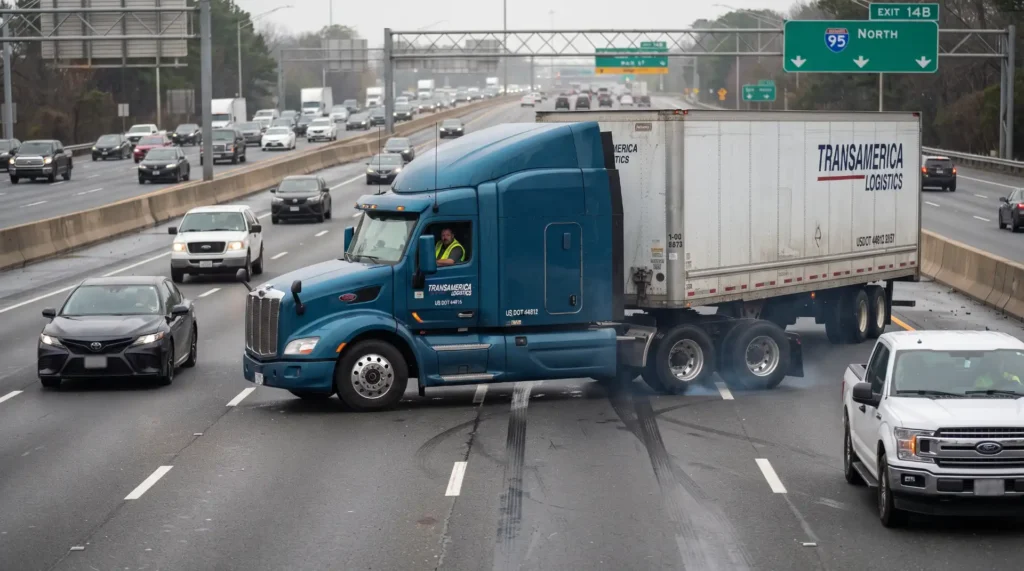
A jackknife truck accident can happen in only a few seconds, but the consequences may continue for months or years. When a tractor-trailer loses control and its trailer swings sharply away from the cab, the truck can occupy several lanes of a highway and create a dangerous obstacle for surrounding motorists. Passenger vehicles may have little time to react, particularly when a jackknifing truck moves across traffic at highway speed.
Unlike an ordinary rear-end or lane-change collision, a jackknife crash can involve several separate impacts. A passenger vehicle may strike the trailer, another vehicle may collide with the first vehicle, or motorists may crash while trying to avoid the truck. The truck itself can also strike a median, barrier, bridge structure, or roadside object.
Federal transportation data recognizes jackknife events as a specific type of crash involving articulated vehicles. Federal Motor Carrier Safety Administration data has documented jackknife involvement in large-truck crashes, while federal crash-causation research has identified jackknifing among vehicle-related factors associated with large-truck crashes.
Determining who is legally responsible, however, requires more than simply observing that a truck jackknifed. Investigators may need to determine what caused the loss of control, whether the driver reacted appropriately, whether the truck was properly maintained, whether cargo was loaded correctly, and whether a trucking company or another party contributed to the collision.
For someone injured in a jackknife truck accident, understanding how these crashes happen and how liability can be established is an important first step.
What Is a Jackknife Truck Accident?
A jackknife accident generally involves an articulated vehicle, such as a tractor-trailer, in which the tractor and trailer move out of alignment. Instead of the trailer following directly behind the tractor, the trailer swings outward, creating an angle between the two sections.
The term comes from the visual appearance of the truck during the event. The tractor and trailer can resemble a folding pocketknife, with the two sections forming a sharp angle.
The National Highway Traffic Safety Administration’s crash-data definitions describe a jackknife as an uncontrolled articulation in which the trailing unit does not follow directly behind the power unit. The federal definition also distinguishes an actual jackknife from controlled articulation, such as a truck turning or backing normally.
This distinction matters because a truck sitting at an angle after a collision does not automatically prove that a jackknife occurred. Accident investigators generally need to examine the sequence of events, vehicle movement, roadway evidence, photographs, electronic information, and witness accounts.
A jackknife can occur before the truck hits another vehicle, or it can occur during a larger collision sequence. Federal crash data recognizes jackknife as something that can occur during the crash sequence rather than necessarily being the first event.
That means an investigation should examine what happened immediately before the truck lost control and what happened afterward.
Why Do Tractor-Trailers Jackknife?
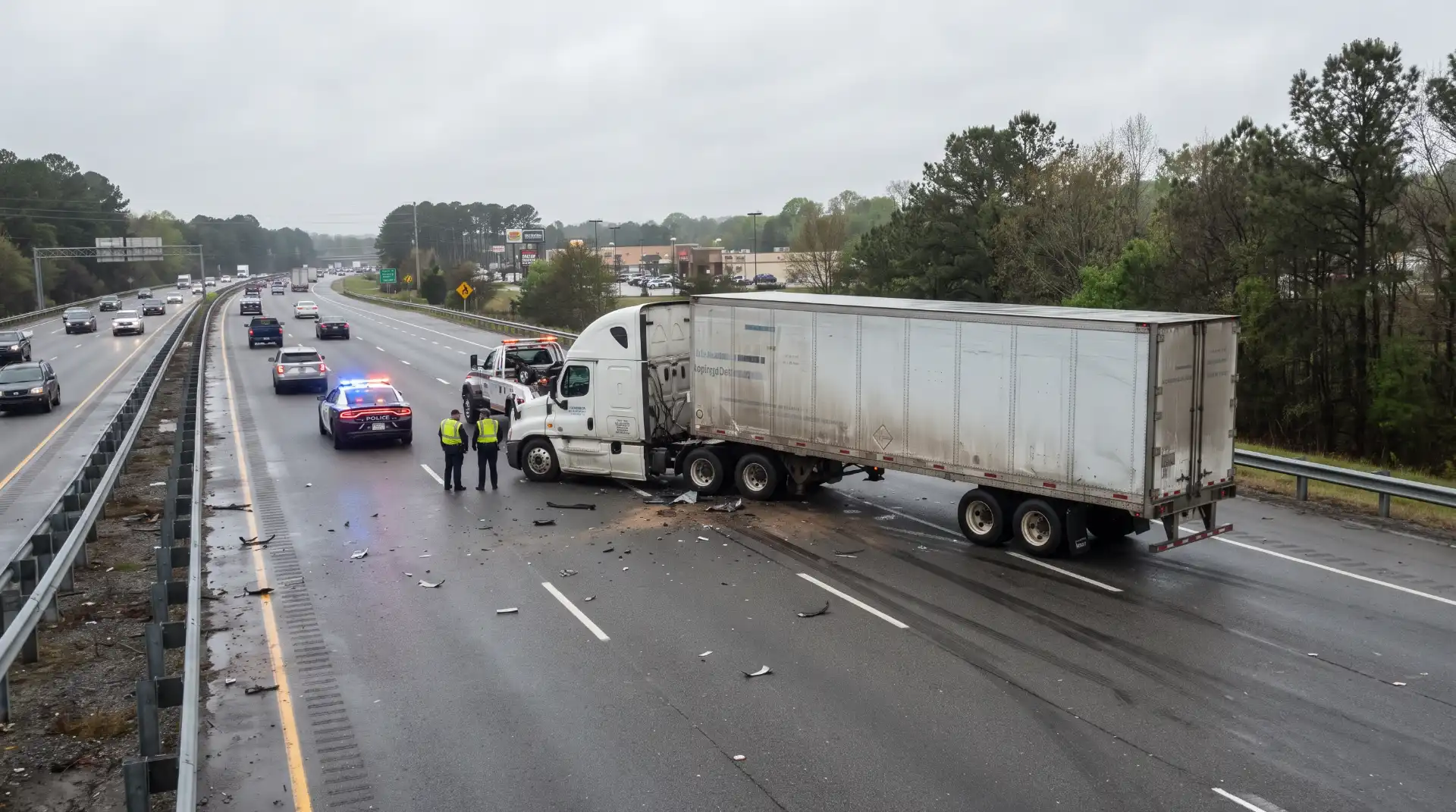
Jackknife crashes can have many causes. In some cases, the truck driver may lose control because of excessive speed, sudden braking, an improper maneuver, or another driving error. In other situations, mechanical problems, roadway conditions, cargo issues, or another driver’s actions may contribute.
Federal research into large-truck crashes has identified numerous contributing factors, including driver inattention, excessive speed for conditions, following too closely, tire problems, brake problems, cargo shift, and other vehicle or roadway factors.
Because multiple factors can contribute to the same crash, it is important not to assume that the truck driver is automatically responsible simply because the truck jackknifed.
Sudden or Excessive Braking
One common mechanism behind a jackknife involves heavy braking. When the tractor and trailer do not maintain proper alignment during hard braking, the trailer can begin moving differently from the tractor.
If traction is limited, the risk can become greater. A wet, icy, snowy, or otherwise slippery roadway can reduce tire grip and make it more difficult for a truck to remain under control.
Heavy trucks also require substantially more distance to stop than passenger vehicles under many circumstances. A driver who reacts late to slowing traffic may apply the brakes aggressively, potentially creating conditions in which the tractor and trailer move out of alignment.
Whether braking caused a particular jackknife must be determined from the evidence rather than assumed from the appearance of the vehicles after the collision.
Excessive Speed
Speed can also be significant. A tractor-trailer traveling too fast for traffic, weather, roadway, or cargo conditions may have less time and distance available to respond to an unexpected hazard.
Speed does not necessarily mean that a driver exceeded the posted speed limit. A speed that is technically within the limit may still be inappropriate for certain conditions.
For example, a truck traveling on a wet downhill roadway may require different handling than the same truck traveling on a dry, level highway. Investigators may therefore examine speed in relation to the roadway, weather, traffic, vehicle weight, and sequence of events.
Wet, Icy, or Snow-Covered Roads
Roadway traction is particularly important for commercial trucks because the interaction between the tires, tractor, trailer, and road surface can change quickly when conditions deteriorate.
Rain can create slippery pavement, while snow and ice can dramatically reduce traction. In some circumstances, water accumulation can also increase the risk of loss of control.
Weather alone does not necessarily establish liability. The important question may be whether the driver operated the truck appropriately for the conditions and whether the trucking company or another responsible party contributed to the unsafe circumstances.
Tire Problems
Tire condition can play an important role in a commercial truck crash. A damaged, underinflated, worn, or defective tire can affect vehicle handling and braking.
Federal large-truck crash research has identified tire problems among vehicle-associated factors in the study population.
After a jackknife accident, investigators may therefore examine the tires, tire-pressure information, maintenance records, inspection records, and other evidence that can help establish whether a tire problem contributed to the loss of control.
Brake Problems
Braking systems are another important area of investigation. A commercial truck depends on properly functioning braking components to slow and stop its considerable weight.
A brake problem does not automatically prove that a trucking company was negligent. Investigators may need to determine what failed, when the problem developed, whether it should have been detected during inspection, and whether required maintenance or repairs were performed.
If a mechanical failure contributed to the crash, responsibility may potentially extend beyond the driver.
Improperly Loaded or Shifted Cargo
Cargo can influence the stability and handling of a commercial vehicle. If freight is improperly distributed, inadequately secured, or allowed to shift during transportation, the truck’s handling characteristics can change.
Federal crash-causation research found cargo shift to be among the vehicle-associated factors examined in large-truck crashes and reported a particularly high relative risk ratio for pre-crash cargo shift in its study data.
A cargo-related jackknife can therefore require an investigation into who loaded the freight, who secured it, what instructions were provided, and whether the load complied with applicable requirements.
How a Jackknife Can Turn Into a Multi-Vehicle Crash
The danger of a jackknife is not limited to the truck itself. The trailer can swing across lanes and create a large moving barrier for vehicles traveling nearby.
Consider a tractor-trailer traveling on a busy interstate. If the truck suddenly loses control, the trailer can move sideways into adjacent lanes. A driver traveling next to the truck may have only seconds to react.
One vehicle may collide with the trailer. A second vehicle may then strike the first vehicle. Other motorists may brake suddenly or swerve, potentially producing additional collisions.
This chain reaction can make liability more complicated.
A person injured in the crash may have been struck by the truck directly, or may have been injured in a secondary collision caused by the truck’s movement. The legal analysis can depend on the precise sequence of events and whether the truck’s conduct was a substantial factor in causing the resulting injuries.
Who May Be Liable for a Jackknife Truck Accident?
Liability in a jackknife truck accident depends on the facts. Several different parties may potentially be involved.
The truck driver is one possible responsible party if negligent driving caused the crash. Examples could include driving too fast for conditions, following too closely, making an unsafe maneuver, or failing to respond appropriately to an obvious hazard.
However, the driver is not necessarily the only person or company that should be investigated.
The Trucking Company
A trucking company may potentially bear responsibility when its own conduct contributed to the accident.
Depending on the circumstances, an investigation might examine hiring practices, driver supervision, training, maintenance procedures, scheduling, dispatch practices, or company policies.
Federal crash research has identified pressure from motor carriers as one of the associated factors examined in large-truck crashes, although the presence of such a factor in research data does not establish that every trucking company or driver operates improperly.
In an individual case, the relevant question is what the particular company knew, what it was required to do, and whether its conduct contributed to the crash.
A Trucking Maintenance Provider
Some trucking companies use outside businesses for inspections, repairs, tire services, or other maintenance.
If a negligent repair or inspection contributed to a mechanical failure, the maintenance provider could potentially become part of the liability analysis.
For example, if a critical braking component was improperly repaired and that failure contributed to the jackknife, records from the repair facility could become important evidence.
A Cargo Loader or Shipper
Cargo-related crashes can raise questions about the company or individual responsible for loading and securing freight.
If cargo was improperly distributed or secured and shifted during transportation, the investigation may need to identify who handled the load and what procedures were followed.
Determining responsibility can be especially important when the truck driver did not personally load the trailer.
A Vehicle or Parts Manufacturer
In some cases, a defective component could contribute to a crash. If a tire, brake component, coupling component, or other part failed because of a manufacturing defect, product-liability issues may arise.
These cases can require technical investigation and expert analysis. Evidence from the failed component should generally be preserved because its condition may become important in determining what caused the crash.
Another Motorist
Not every jackknife crash is caused by the truck driver.
A passenger vehicle may suddenly cut in front of a truck, stop unexpectedly, make an unsafe lane change, or otherwise create an emergency situation. The truck driver may then attempt to avoid the vehicle and lose control.
In such circumstances, the actions of the other motorist may become an important part of the liability investigation.
A complete investigation should therefore consider the conduct of every relevant driver rather than assuming responsibility based solely on the size of the truck.
How Liability Is Investigated After a Jackknife Crash
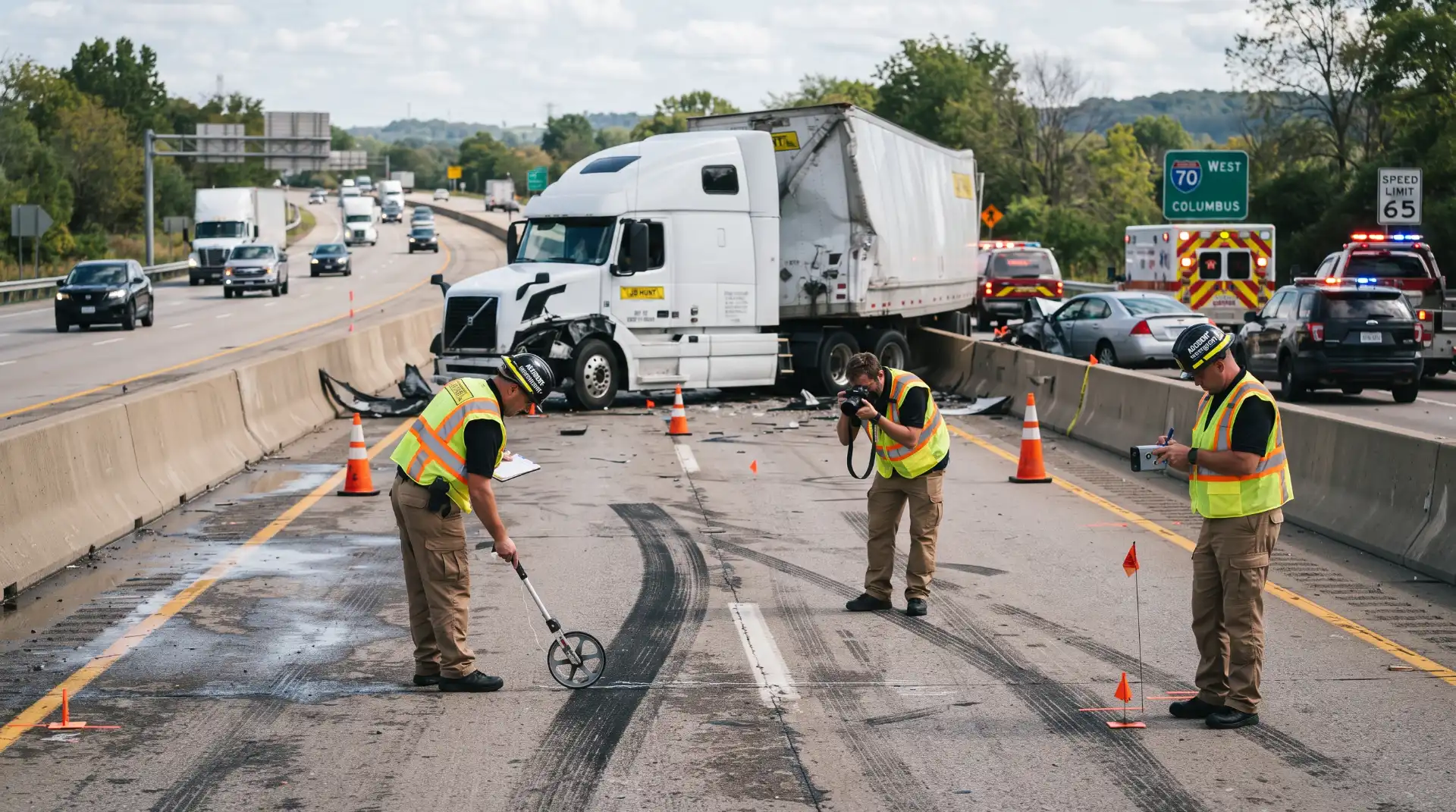
Determining liability often requires reconstructing the crash from multiple sources of evidence.
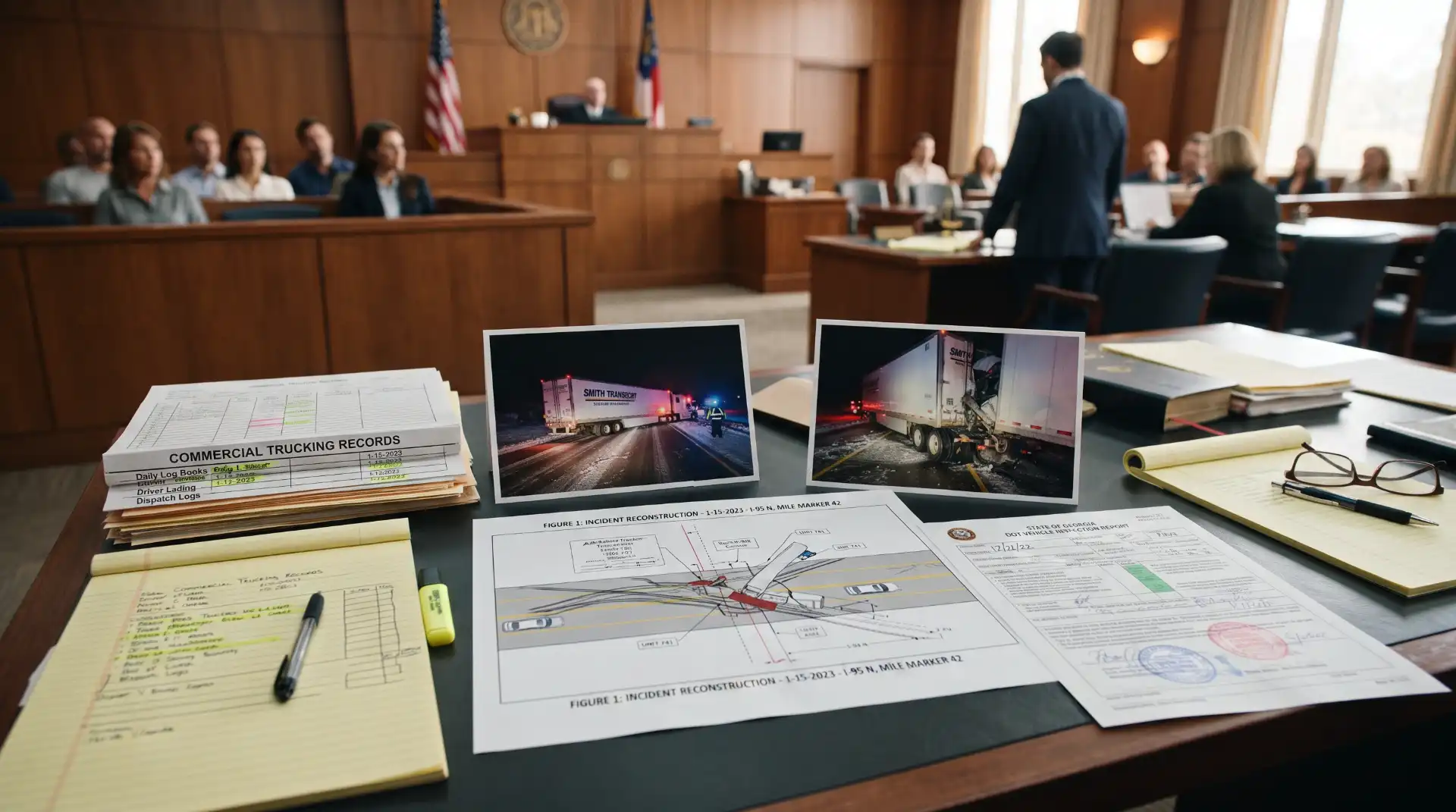
The physical evidence at the accident scene can be particularly valuable. Investigators may examine tire marks, skid marks, debris fields, vehicle positions, damage patterns, roadway conditions, and the final resting positions of the vehicles.
Photographs taken shortly after the crash can preserve details that may disappear once vehicles are moved and the roadway is cleaned.
Vehicle damage can also provide important information. The location and severity of damage may help investigators understand the direction of impact and the sequence of collisions.
Electronic Truck Data
Modern commercial trucks can generate electronic information that may help investigators understand what happened before a crash.
Depending on the truck and circumstances, potentially relevant information can include speed, braking activity, engine information, and other vehicle data.
Electronic logging information may also provide information concerning a driver’s recorded duty status. Such records can become relevant when fatigue or hours-of-service compliance is part of the investigation.
However, electronic data should be interpreted carefully. A single data point rarely explains an entire crash, and the relevance of particular records depends on the vehicle, system, circumstances, and applicable rules.
Driver Records
A commercial driver’s qualifications and history may also become relevant.
Investigators may examine the driver’s commercial driver’s license status, training, qualification records, previous safety-related information, and other records when appropriate.
The purpose is not simply to search for something negative about the driver. Instead, investigators should determine whether there was information that a responsible party knew or should have known and whether that information relates to the accident.
Truck Maintenance Records
Maintenance records can be especially important when the crash involves braking, tires, steering, coupling equipment, or another mechanical component.
Records may help establish whether inspections were performed, whether defects were reported, whether repairs were completed, and whether the truck was placed back into service after a problem was identified.
Preserving the physical vehicle can also be critical when a mechanical defect is suspected.
Black Box and Event Data
People often use the term “black box” to describe electronic information recorded by a vehicle. In commercial trucks, the specific system and information available can vary.
Investigators may need to determine what technology was installed in the particular truck and what information it retained.
This evidence can sometimes help establish the truck’s movements immediately before a crash, but it should be combined with other evidence rather than treated as the complete explanation.
Injuries Commonly Associated With Jackknife Crashes
Jackknife collisions can expose occupants of passenger vehicles to severe forces. The size and weight difference between a tractor-trailer and a passenger car can make a collision particularly dangerous.
Injuries may include broken bones, spinal injuries, traumatic brain injuries, internal injuries, soft-tissue damage, and serious lacerations. Some victims may require emergency surgery, hospitalization, rehabilitation, or long-term medical care.
The physical consequences can extend beyond the initial treatment.
A serious injury may affect someone’s ability to work, care for family members, drive, exercise, or perform ordinary daily activities. Some injuries may also require continuing treatment long after the accident scene has been cleared.
For this reason, a truck accident investigation should consider not only the immediate medical bills but also the broader consequences of the injury.
What Evidence Should Be Preserved?
Evidence can disappear quickly after a commercial truck crash.
The vehicles may be repaired, sold, or destroyed. Electronic information may be overwritten or become more difficult to retrieve. Surveillance footage may be automatically deleted. Witnesses may become difficult to locate, and memories can change over time.
For these reasons, preservation of evidence can be especially important in a jackknife case.
Photographs and videos from the accident scene can help document vehicle positions, road conditions, traffic patterns, weather, visible damage, and other details.
Medical records can establish the nature and extent of injuries. Employment records can help document lost income when an injury prevents someone from working.
Witness information may also be valuable, particularly when the crash involved multiple vehicles.
An attorney investigating a serious commercial truck accident may also seek trucking-company records, maintenance documentation, driver records, electronic data, inspection information, cargo records, and other relevant evidence.
Why Truck Accident Cases Can Be More Complicated Than Ordinary Car Accidents
A truck accident may involve considerably more evidence and potentially more responsible parties than a typical two-car collision.
There may be a driver, trucking company, owner of the tractor, owner of the trailer, shipper, broker, maintenance provider, insurer, and potentially manufacturers or other parties connected to the vehicle or cargo.
The truck may also be subject to federal and state commercial-vehicle requirements that do not apply in the same way to ordinary passenger vehicles.
That does not mean every truck accident automatically produces a complex lawsuit. It does mean that serious crashes often deserve a careful investigation before responsibility is assigned.
What Should You Do After a Jackknife Truck Accident?
If you are involved in a jackknife truck crash, your immediate priority should be safety and medical attention.
If emergency services are available, injured people should receive appropriate medical evaluation. Some serious injuries may not be immediately obvious after a high-impact collision.
If you are physically able to do so safely, photographs and video of the vehicles, roadway, debris, traffic conditions, and surrounding area can help preserve evidence.
You should also exchange information as appropriate and obtain the responding agency’s report information.
After a serious crash, be cautious about making statements that speculate about fault. The causes of a jackknife accident can be complicated, and the initial appearance of the crash scene may not reveal the entire sequence.
If the collision resulted in significant injuries or substantial property damage, preserving evidence and obtaining legal advice promptly may help protect important rights.
How Insurance Works After a Jackknife Truck Accident
Commercial trucks typically involve insurance arrangements that can be different from those associated with ordinary passenger vehicles.
A serious crash may involve commercial liability coverage as well as additional policies or coverage associated with particular parties.
Insurance companies may begin investigating a major truck accident quickly. Their investigators may inspect vehicles, review photographs, speak with witnesses, and gather other evidence.
An injured person should therefore understand that the trucking company and its insurer may already be working to establish their own version of what happened.
That is another reason why preserving independent evidence can be important.
The amount of insurance coverage available does not automatically determine the value of an injury claim. The nature of the injuries, medical treatment, lost income, liability, available insurance, and other circumstances can all affect the legal and financial issues involved.
How Comparative Fault May Affect a Truck Accident Claim
In some cases, more than one person may contribute to a crash.
For example, a truck driver may have made an unsafe maneuver while another motorist was speeding or changing lanes improperly. The investigation may need to determine how each action contributed to the collision.
Rules concerning comparative fault vary by state. Because this is a U.S.-focused issue, the applicable state law can make a significant difference in how damages are calculated.
A person involved in a jackknife crash should therefore avoid assuming that a general statement about comparative negligence applies identically throughout the country.
The location of the accident, the parties involved, the evidence, and the state’s applicable law all matter.
The Importance of Accident Reconstruction
Accident reconstruction can be particularly useful when a jackknife crash involves several vehicles or conflicting accounts.
A reconstruction expert may examine vehicle damage, skid marks, event data, photographs, roadway measurements, vehicle specifications, and other information to determine how the collision unfolded.
The objective is to establish a scientifically supported sequence of events.
For example, reconstruction may help answer questions about where the truck was traveling, how quickly it was moving, when braking occurred, how the trailer began rotating, and when contact with other vehicles happened.
Reconstruction does not automatically establish legal liability. Instead, it can provide evidence that attorneys, insurers, and courts can consider alongside other information.
What Makes a Jackknife Crash Different From a Rollover?
Jackknife and rollover crashes can occur together, but they describe different vehicle movements.
A jackknife involves the tractor and trailer moving out of alignment, while a rollover involves the vehicle or trailer overturning.
A truck can jackknife without rolling over. Likewise, a rollover can occur without a traditional jackknife.
Understanding the distinction can be important when reviewing crash reports and investigating the actual sequence of events.
Federal crash data separately identifies jackknife and rollover events, illustrating that they are distinct crash characteristics even though they may occur during the same incident.
Jackknife Accidents Can Have Serious Consequences
The federal government’s large-truck crash data demonstrates that jackknife events are a recognized part of commercial truck crash patterns. For example, FMCSA’s 2020 data identified 169 large trucks involved in fatal crashes in which a jackknife occurred, with additional jackknife involvement recorded in injury and property-damage crashes.
Earlier federal data similarly recorded jackknife involvement in fatal large-truck crashes. In the 2019 data, 172 large trucks in fatal crashes were coded as having experienced a jackknife, while 2020 recorded 169.
These figures should be interpreted carefully because they describe recorded crash characteristics and do not mean that every jackknife was the primary cause of a collision.
Still, the data illustrates why jackknife events deserve attention when discussing commercial truck safety and accident investigation.
What Can a Jackknife Truck Accident Claim Include?
When another party’s negligence causes a serious crash, an injured person may potentially seek compensation for damages recognized under applicable state law.
Depending on the circumstances, damages may involve medical expenses, future medical care, lost wages, reduced earning capacity, property damage, and other losses associated with the injury.
Some jurisdictions also recognize damages related to pain and suffering or other non-economic consequences.
The exact categories and calculation methods vary by state, which makes location particularly important in truck accident cases.
A claim should be evaluated based on the actual injuries and losses rather than relying on a generic settlement figure found online.
Why Prompt Investigation Matters
Commercial trucking cases can involve evidence that is difficult to obtain later.
A damaged tractor or trailer may be repaired. A vehicle may be moved from a storage facility. Electronic records may have limited retention periods. Surveillance footage may disappear. Cargo may be unloaded, transferred, or discarded.
Prompt investigation can therefore help preserve evidence before important information becomes unavailable.
This is particularly important when the cause of the jackknife is disputed.
If one party claims the truck driver suddenly faced an unavoidable emergency while another claims the truck was traveling too fast or was improperly maintained, the available physical and electronic evidence may become central to resolving the dispute.
Understanding Responsibility After a Jackknife Truck Accident
A jackknife accident should not automatically be treated as a simple case of “the truck driver was at fault.”
The truck driver may be responsible in some cases, but other possibilities should also be investigated. A mechanical defect, inadequate maintenance, cargo problem, another motorist’s actions, roadway conditions, or trucking-company practices may have contributed.
Federal crash research reinforces the fact that large-truck crashes can involve numerous driver, vehicle, and roadway factors.
The strongest approach is therefore to examine the complete chain of events.
What happened immediately before the truck lost control? How fast was it traveling? What were the weather and roadway conditions? Was the driver braking? Was the truck properly maintained? Was the cargo properly secured? Did another vehicle create an emergency? Were there warnings or mechanical problems before the collision?
Those questions can help move the investigation beyond assumptions and toward evidence.
Final Thoughts
Jackknife truck accidents can be among the most disruptive commercial vehicle crashes because a tractor-trailer can suddenly swing across multiple lanes and create a hazard for several motorists at once.
The causes can vary significantly. Braking, speed, roadway conditions, tires, brakes, cargo, driver decisions, maintenance, and the actions of other motorists can all become relevant depending on the circumstances.
Determining liability requires a fact-specific investigation. The driver may be responsible, but the trucking company, maintenance provider, cargo-related parties, manufacturer, or another motorist may also need to be considered.
For someone injured in a jackknife truck accident, preserving evidence and understanding the applicable state law can be important. Medical documentation, photographs, witness information, vehicle evidence, electronic records, maintenance records, and accident-reconstruction evidence may all help establish what happened.